
Bcrypt vs Argon2: Which Password Hashing Algorithm is Safer?
Bcrypt vs Argon2 — choosing the wrong password hashing algorithm can make the difference between a minor breach and a catastrophic one. This guide compares both head-to-head: speed, security, GPU resistance, and the clear 2026 recommendation.
Bcrypt vs Argon2 — Why Password Hashing Matters
In the bcrypt vs argon2 debate, both algorithms exist to solve a critical problem: every week, thousands of databases are breached and user credentials are exposed. If passwords are stored as plain text or with weak hashing (MD5, SHA-1), attackers can crack every single one within hours using modern hardware.
Password hashing is a one-way process that converts a password into a fixed-length string called a hash. You cannot reverse a hash back to the original password. Understanding the bcrypt vs argon2 difference helps you choose the right level of protection — a good password hashing algorithm is deliberately slow to compute, making brute-force and dictionary attacks computationally expensive.
MD5, SHA-1, SHA-256, SHA-512, and Base64 are all wrong for passwords. They are designed to be fast — meaning attackers can try billions of combinations per second. Always use a purpose-built password hashing algorithm like Bcrypt or Argon2.
Bcrypt vs Argon2 — What is Bcrypt?
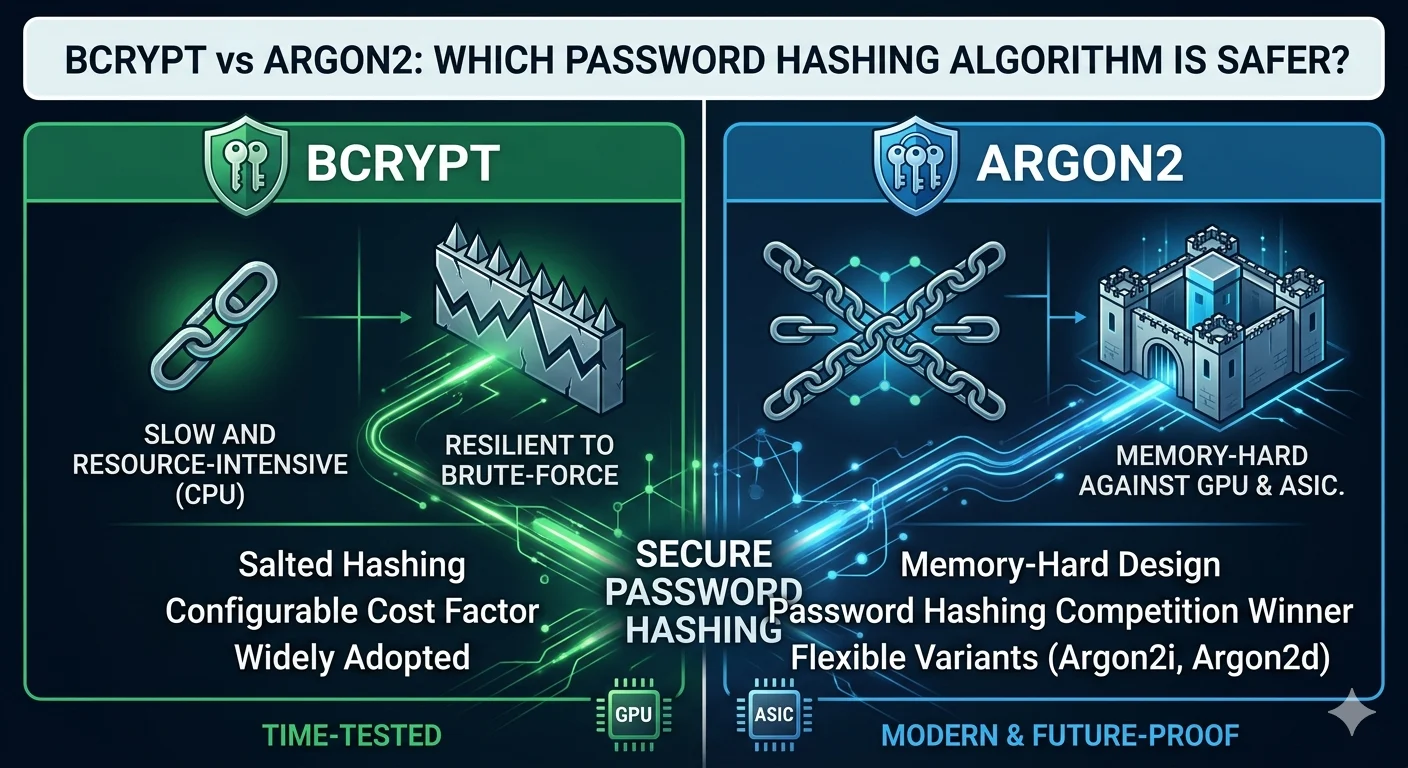
In any bcrypt vs argon2 comparison, Bcrypt is the veteran. Bcrypt was designed by Niels Provos and David Mazières in 1999, based on the Blowfish cipher. It was one of the first password hashing functions designed with deliberate slowness in mind. It remains one of the most widely used algorithms today due to its long track record and broad library support.
The key feature of Bcrypt is its cost factor (also called work factor). Each increment doubles the computation time. Cost factor 10 takes ~100ms, cost factor 12 takes ~400ms. This keeps Bcrypt relevant even as hardware gets faster — you simply increase the cost.
Bcrypt vs Argon2 — What is Argon2?
The bcrypt vs argon2 question tilts heavily toward Argon2 in modern security contexts. Argon2 won the Password Hashing Competition (PHC) in 2015, beating 24 other algorithms. It was specifically designed to resist GPU and ASIC attacks by being memory-hard — meaning it requires large amounts of RAM to compute, which makes parallel cracking on graphics cards extremely expensive.
Argon2 has three variants:
- Argon2d — maximizes resistance to GPU cracking, but vulnerable to side-channel attacks
- Argon2i — resistant to side-channel attacks, recommended for password hashing
- Argon2id — hybrid of both, recommended by OWASP for most use cases
Bcrypt vs Argon2 — Full Technical Comparison
| Feature | Bcrypt | Argon2id |
|---|---|---|
| Year Designed | 1999 | 2015 NEWER |
| GPU Attack Resistance | Moderate | High (memory-hard) WIN |
| ASIC Attack Resistance | Low | High WIN |
| Memory Hardness | ❌ None | ✅ Configurable WIN |
| Password Length Limit | 72 bytes max | No limit WIN |
| Side-channel Resistance | Partial | ✅ Yes (Argon2id) WIN |
| Tuning Parameters | 1 (cost factor) | 3 (memory, time, threads) WIN |
| Library Support | Excellent (every language) | Good (growing) |
| Ease of Use | Very simple WIN | Slightly more config |
| Legacy System Support | Excellent WIN | Limited in older stacks |
| OWASP Recommendation | Option 2 | Option 1 (first choice) WIN |
| PHC Competition | Not entered | Winner 2015 WIN |
Bcrypt vs Argon2 — Code Examples
Bcrypt in Node.js
Node.js — bcryptconst bcrypt = require('bcrypt'); // Hash a password (cost factor 12 = ~400ms) async function hashPassword(plaintext) { const saltRounds = 12; const hash = await bcrypt.hash(plaintext, saltRounds); return hash; } async function verifyPassword(plaintext, storedHash) { const match = await bcrypt.compare(plaintext, storedHash); return match; }
Argon2id in Node.js
Node.js — argon2const argon2 = require('argon2'); async function hashPassword(plaintext) { const hash = await argon2.hash(plaintext, { type: argon2.argon2id, memoryCost: 65536, timeCost: 3, parallelism: 4, }); return hash; } async function verifyPassword(plaintext, storedHash) { return await argon2.verify(storedHash, plaintext); }
Python — Both Algorithms
Python# Bcrypt in Python import bcrypt password = b"mySecurePassword!" hashed = bcrypt.hashpw(password, bcrypt.gensalt(rounds=12)) # Argon2 in Python from argon2 import PasswordHasher ph = PasswordHasher(time_cost=3, memory_cost=65536, parallelism=4) hash = ph.hash("mySecurePassword!")
Try Both Hash Generators Online
You can generate and test both Bcrypt and Argon2 hashes directly in your browser using free tools — no installation, no server processing:
- jsonformatterxml.com/bcrypt-hash-generator/ — Generate and verify Bcrypt hashes online
- jsonformatterxml.com/argon2-hash-generator/ — Generate Argon2id hashes with custom parameters
Frequently Asked Questions
Conclusion
The bcrypt vs argon2 verdict for 2026 is clear: for any new application, Argon2id is the winner. It is memory-hard, GPU-resistant, PHC-certified, and OWASP’s first recommendation. The slight learning curve of configuring three parameters (memory, time, parallelism) is worth it for significantly stronger password protection.
If you are maintaining a system already using Bcrypt — it is still safe with cost factor ≥ 10. Plan a gradual migration to Argon2id as users log in. The bcrypt vs argon2 migration strategy is simple: re-hash on next login. Never under any circumstance use MD5, SHA-256, or Base64 for password storage.
Generate Password Hashes Online
Test Bcrypt and Argon2 hash generation instantly — free, private, browser-based.
